If you’ve ever walked through a high-volume aerospace, automotive, or medical parts shop, you’ve likely noticed the machine that turns a block of solid metal into a complex component faster and more accurately than any other tool in the facility: the 5 Axis Machining Center. As a supplier of these systems, I get to talk to shop owners and production managers every week who tell me they thought 5 axis tech was reserved for exotic, low-run parts—until they realized their 3 axis machines were leaving gaps in accuracy, wasting material, or taking twice as long to finish parts that needed angled surfaces, deep cavities, or precise internal geometries. The biggest question I hear? How does this machine actually adjust to completely different machining requirements, mid-job and mid-shift, without constant manual reconfiguration that kills productivity? Let me break it down, from the core mechanical systems that make the adjustment possible, to the software that’s the real unsung hero of this technology. 5 Axis Machining Center

First, let’s get the basics straight: what makes a 5 axis machine different from its 3 axis cousin? A standard 3 axis machine moves a tool along X, Y, and Z linear axes, perfect for flat surfaces and simple holes, but if you need to machine a turbine blade’s twisted aerofoil, a custom hip implant’s curved socket, or a mold’s angled undercut that’s hidden inside a block of steel, you’re stuck in a bind. You could re-fixture the part, but that adds hours of setup, risks alignment errors, and requires manual hand finishing that eats into quality. A 5 axis machine adds two rotational axes—usually labeled A and B, or sometimes A and C, depending on the machine design—that let the tool or the part tilt and rotate to any angle in space. That might sound like a simple add-on, but those two axes are the foundation of how the machine adapts to every new job, no matter how different the requirements are.
The first way a 5 axis machining center adjusts is through its configurable axis configuration, tailored to part size and geometry needs. When we design machines for our customers, we don’t build a one-size-fits-all rotational axis; we offer three core types, each built for specific machining demands. For customers making small, delicate medical implants or intricate mold inserts, we use a table-tilting, table-rotational design (often called a ‘trunnion’ setup) where the part sits on a rotating and tilting table, and the tool moves linearly along X, Y, Z. This setup is ideal for parts that only need a few angled surfaces, and it’s fast to adjust between jobs because the trunnion can be calibrated in minutes, not hours. For larger parts like aircraft wing ribs or locomotive components, we offer a head-tilting, head-rotational design, where the tool itself tilts and rotates, leaving the part fixed to a large floor plate—this eliminates weight limits on the part, so a 10,000 pound titanium component doesn’t have to be moved mid-job to machine its top and sides. For even more extreme applications, like making large wind turbine gear hubs, we have custom multi-axis setups that combine both table and head rotation, letting the machine reach every surface without the tool colliding with the part or the fixture. That’s the first big adjustment: matching the rotational axis setup to the job’s size and geometry before the machine even runs, and being able to swap or calibrate that setup quickly for completely different part types.
Next, the machine’s control system is the brains that adjusts in real time to machining requirements, and this is where most people underestimate how dynamic these systems are. A few years ago, a 5 axis machine might have required hours of manual CAM programming for every new angle, with the operator having to tweak each line of code to avoid errors. Today, modern controls (like the Siemens Sinumerik or FANUC 30i, which we integrate into all our systems) do the heavy lifting automatically. Let’s say a customer switches from machining a small, curved aluminum bracket that needs low-speed, high-precision finishing to a thick steel engine component that needs high-speed, heavy-duty roughing. The control system doesn’t just adjust speeds and feeds— it adjusts every axis’s movement to match the material and operation. For roughing steel, the system will loosen the rotational axes’ hold slightly (in a controlled, programmed way) to absorb the extra torque from the cutting tool, reducing stress on the machine and getting a deep cut done fast. For finishing aluminum, it tightens the rotational axes to eliminate any tiny vibration, so the tool moves with micron-level precision along the curved surface, no hand sanding needed. It also adjusts the tool center point (TCP) automatically—this is the single most important adjustment the machine makes, and it’s a feature that’s unique to 5 axis tech. The TCP is the exact point where the cutting edge meets the part, and when the machine tilts or rotates, the control recalculates that point in 3D space in real time, so the tool doesn’t drift off the desired path, even when the axis is at a 60-degree tilt. If a job calls for a 10mm ball end mill vs. a 20mm roughing end mill, the operator just inputs the tool diameter and length, and the control adjusts the TCP instantly—no re-coding needed, and no chance of misalignment from manual tool measurements. That’s how a single machine can go from machining a delicate medical screw (requiring a tiny, 0.5mm end mill) to machining a large, thick mold cavity (requiring a large face mill) without any manual re-calibration of axis positioning.
Another key adjustment is the machine’s ability to switch between machining strategies in seconds, without operator input, based on the job’s requirements. Machining isn’t just cutting metal—it’s roughing, semi-finishing, finishing, and sometimes even drilling or tapping, each with completely different needs. For a long time, shops would have to call a machinist to re-program the machine to switch from roughing (where you remove as much material as fast as possible) to finishing (where you remove as little as possible to get a smooth surface). Today’s 5 axis controls use what’s called ‘adaptive machining’ software, built directly into the machine’s operating system, that detects changes in material hardness, tool wear, and cut depth in real time and adjusts the axis movement automatically. For example, if a part has a deep pocket that requires a long tool to reach the bottom, the control will tilt the rotational axes to keep the tool at a shallow angle relative to the pocket walls, reducing the chance of tool deflection and breakage. If the control detects that the tool is wearing out (via built-in load sensors that measure torque on the spindle), it will slow the feed rate slightly and adjust the tilt angle to distribute the wear more evenly, so the tool lasts longer and the part stays within tolerance. We recently installed a system for an aerospace customer that switches between 12 different machining strategies in a single run of a turbine blade: roughing the core, finishing the leading edge, polishing the trailing edge, and drilling cooling holes at 15 different angles. The machine adjusts its axes up to 60 times per second, without stopping, and the part comes out within 0.002mm tolerance—something that would have required 3 different machines and 8 hours of manual work in the past.
One of the most underrated adjustments a 5 axis machining center makes is to its own maintenance and performance, based on what it’s machining. A lot of people don’t realize that these machines have built-in sensors that monitor every axis, spindle, and linear guide, and adjust their parameters based on the workload. If a customer is running high-volume, roughing work with heavy cuts on steel, the machine will automatically increase the grease flow to the linear guides and adjust the axis acceleration to reduce heat buildup, preventing premature wear. If the customer switches to fine finishing on soft aluminum, where heat is less of a concern but precision is everything, the machine will slow the axis acceleration to a minimum and increase the spindle speed to get a smooth, burr-free surface. This is a huge advantage for shops that run multiple part types in a single shift—they don’t have to shut down the machine for hours to adjust maintenance settings, and the machine stays consistent across jobs, even when the requirements change daily. I’ve seen shops go from 2 setups per day to 12 setups per day after installing our 5 axis systems, just because the machine adjusts so quickly between different requirements, without any downtime or manual adjustment.
Of course, no discussion of 5 axis adjustment would be complete without talking about collision avoidance, a feature that’s non-negotiable when working with multiple axis movements and completely different part geometries. When machining a part with a deep undercut or a complex internal cavity, the last thing you want is the tool or spindle hitting the part, fixture, or machine bed. Modern 5 axis controls have a 3D model of the entire machine, fixture, and part built into their software, and they simulate every axis movement in real time before the tool moves. If the job requires a tilt angle that would cause a collision, the machine automatically adjusts the rotational axes to a safe angle, or even stops the tool before any damage is done. This is a critical adjustment that happens seamlessly, without the operator even noticing, and it’s what lets shops run lights-out shifts—when a shop closes for the night, the machine can run unsupervised, switching between machining jobs and adjusting to different requirements, because it’s always watching for collisions and adapting to keep the process safe.
As a supplier of 5 axis machining centers, I’ll be the first to say that these machines aren’t magic—they’re a combination of mechanical precision, smart software, and real-time adjustment that solves problems that 3 axis machines can’t. The key to their flexibility is that they don’t just move along axes, they adapt to the job’s needs: matching the axis configuration, adjusting the tool center point, switching machining strategies, monitoring and adjusting for wear, and avoiding collisions, all in milliseconds. For shops that used to have to invest in multiple machines for different job types, a single 5 axis machine can now handle roughing, finishing, drilling, and complex surface machining, all in one setup.
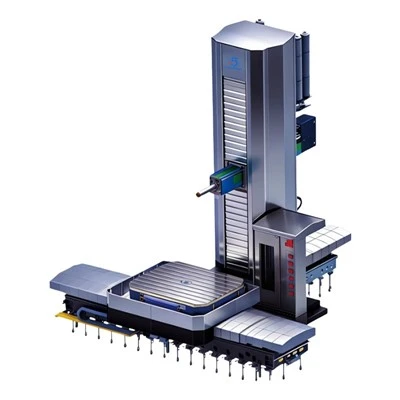
If you’re a shop owner, production manager, or engineer who’s tired of dealing with long setup times, poor surface finishes, or machines that can’t keep up with new, more complex part requirements, it’s time to talk about how a 5 axis machining center can adjust to your specific needs. Whether you’re running small medical parts, large aerospace components, or everything in between, the right system will adapt to your process, not the other way around.
Horizontal Boring Mill CNC References
- Altintas, Y. Manufacturing Automation: Metal Cutting Mechanics, Machine Tool Vibrations, and CNC Design. Cambridge University Press, 2012.
- Tlusty, J. Manufacturing Processes and Equipment. Prentice Hall, 2000.
- “5-Axis Machining: Fundamentals and Best Practices.” Modern Machine Shop, 2021.
- “Advanced CNC Control Systems for Multi-Axis Machining.” Siemens AG, 2022.
- FANUC Corporation. “5-Axis Machining Center Operation and Programming Guide.” 2020.
5Axis (Shandong) CNC Equipment Co., Ltd.
Address: No.2000, Beixin West Road, Jinghe Street, Tengzhou City, Zaozhuang City, Shandong Province
E-mail: summer@good5axis.com
WebSite: https://www.china5axis.com/
